
Searching La Plata County Criminal Dockets
The Colorado Judicial Branch Docket Search is free and official. It covers hearings in La Plata County District Court and County Court alike. Pick La Plata County. Set a date range, and layer on at least one more filter. A complete case number works best. It holds a four-digit year, a class, and a sequence. Felonies usually carry CR. Misdemeanors use M, and state traffic matters use T. You can also narrow results by party, attorney, courtroom, court type, or case sequence.
What you get back is a calendar card, not a criminal history. It names a scheduled event. It may show the date, time, duration, hearing type, court location, appearance type, and courtroom. Use it in that spirit.
- Identify the issuing court before searching. Durango city summonses are not in the state court record system.
- Open Docket Search, select La Plata County, choose the date, and add a case, party, attorney, or courtroom filter.
- Match the court level and case number, then record the latest hearing card rather than an older repeated event.
- Request the Register of Action from the clerk when charges, minute orders, plea events, or disposition history are needed.
- Request a complaint, information, or disposition and sentence order separately when the actual document is required.
When the online docket search falls short, go straight to the clerk. File the Record/Document Request Form. You can also email or call the Combined Courts staff. The counter sits at 1060 East Second Avenue, Suite 106, Durango. Call ahead before you drive over, though. The official local page does not promise a public workstation.
La Plata Criminal Calendar Limits
A hearing card may label an arraignment, an advisement, or a bond appearance. The same list includes a plea hearing, sentencing, probation-revocation setting, or review. Labels name a step. They never prove an outcome. A plea hearing can end in a plea. It can also simply produce another setting, and a sentencing entry only proves sentencing was scheduled. For what the court actually imposed, the signed sentence order is the stronger source.
Calendar versus history: The Colorado docket is a schedule. The Register of Action is the chronological case summary, and filed documents must be requested from the court.
One event can show up twice. The public interface sometimes indexes each party separately. Date range matters too, since a case outside your chosen window stays invisible, and restricted cases may not appear at all. So a missing card is a signal, not a verdict. Check the court, the date range, the spelling, and the access status before concluding anything. It is not proof that no case exists.
Inside a La Plata County Criminal Docket
A criminal Register of Action ties the case header to a dated sequence of events. The public portions can list parties and counsel, the initiating complaint or information, motions, notices, and minute orders. Later entries may cover settings, pleas, disposition entries, sentence orders, probation activity, costs, and appeal events. What you see depends on the file's status. Access varies. Public, protected, restricted, suppressed, and sealed records carry different levels of access.
| Case number | A year, class, and sequence, such as 2026CR1234, used to distinguish the file. |
|---|---|
| Court and division | The District or County Court assignment and the division handling the event. |
| Charge record | The complaint or information and any public charge description or classification. |
| Settings | Date, time, duration, hearing type, location, appearance type, and courtroom. |
| Outcome entries | Plea, disposition, sentence order, probation or revocation activity, costs, and appeal events when public. |
Even then, the ROA is a summary. A minute-order line is not the full minute order. A sentence-order entry is not the signed document. Name the exact document you want on the request form so the Clerk of Court, La Plata County Combined Courts can tell a case history request from a request for a copy of a filing.
La Plata Criminal Docket Labels
Local calendar labels describe steps, not judgments. Reading them plainly keeps a scheduled event from being mistaken for a conviction, a dismissal, or a final sentence.
- Hearing on Advisement
- An early County Court event where the charge, rights, and next steps are addressed.
- Return Filing of Charges
- A return date concerning the prosecution's filing of formal charges.
- Appearance on Bond
- A setting tied to a person's appearance while subject to bond conditions.
- PreTrial Conference
- A setting for readiness, negotiation, and issues that must be resolved before trial.
- Disposition
- The recorded outcome or closure status, which should be read with the later order.
A blank appearance-type box grants nothing. It does not authorize attending remotely. The La Plata County court page requires parties to appear in person unless a phone or Webex appearance was approved ahead of time. If a written notice conflicts with the screen, call 970-247-2304.
How a Criminal Case Moves
A state criminal record usually opens with a complaint or information. An early appearance comes next. From there the court may set advisement, arraignment, bond, plea, pretrial, or readiness events. Motions and minute orders fill the case history between settings. A plea or trial leads to a disposition. A sentence order then records any sentence imposed. Probation review or revocation activity can add later entries. It does so without opening a new public specialty docket.
Docket flow: Charge Filed › Arraignment or Advisement › Pretrial Settings › Plea or Trial › Disposition › Sentencing
No case follows this script exactly. A setting gets continued, a motion shifts the route, or a matter ends before trial. Read the docket dates in order. Hunt for the newest minute order, disposition entry, or signed order.
La Plata Specialty Criminal Dockets
The Sixth Judicial District's Adult Drug Court began in La Plata County in 2001. It blends treatment, intensive supervision, and judicial oversight. Adult Behavioral Health Court followed in 2011. That program unites the court, probation, treatment providers, prosecution, defense, and law enforcement around a treatment-focused model. Juvenile Drug Court relies on phased monitoring. None of these programs runs its own public search portal. Their hearings stay tied to the underlying CR or M case number. So search the ordinary state calendar and request the ordinary ROA. Ask the clerk which program setting sits under the case. That keeps the search anchored to the official file rather than treating a program name as a second docket.
Courts That Hold Criminal Dockets
Offense level splits the criminal docket in La Plata County. Felonies sit in Sixth Judicial District Court. Its case numbers usually carry a CR prefix. County Court holds the misdemeanors and state traffic tickets. It also handles protection-order and advisement matters, plus the early stages of a felony before it moves up. One clerk serves both levels. The Combined Courts clerk in Durango handles filings for District and County Court at a single address. The split between the two courts still matters for any docket search, so know which level your case sits in.
| Court | Criminal docket | Search route |
|---|---|---|
| Sixth Judicial District Court | Felony cases and later District Court proceedings | State Docket Search, then Combined Courts clerk for ROA or documents |
| La Plata County Court | Misdemeanors, state traffic, advisements, and early felony matters | State Docket Search, then the same clerk office |
| Durango Municipal Court | Durango-code traffic, parking, animal, code, and nontraffic summonses | Durango Municipal Court and its clerk |
Where a ticket lands depends on who wrote it. Durango Police and Fort Lewis College Police city summonses go to the municipal court. State Patrol and La Plata County Sheriff cases belong at Combined Courts. Is the court unclear? Check which agency appears on the citation or notice. Start there.
La Plata Criminal Document Requests
One statewide form covers document requests. Fill in La Plata County, the party name, the rough year, the case class, and any number you know. Then choose either an ROA or a criminal document. The checkboxes cover the complaint or information, disposition and sentence order, protection order, and ticket. Older files can carry real retrieval costs, and protected material may require government-issued photo identification.
Costs vary by what you order. A nonparty name search with an ROA runs an estimated $5. Copy pages and certification cost more, so the clerk gives the final quote. Certification never happens automatically; it is a separate service. For a quick status check, the hearing calendar is the place to begin. For charges and the timeline of entries, request the ROA. For the court's signed terms, name the sentence or disposition order. Does the case sit in collections? The Sixth Judicial District collections and payments page lays out the district's route for those obligations.
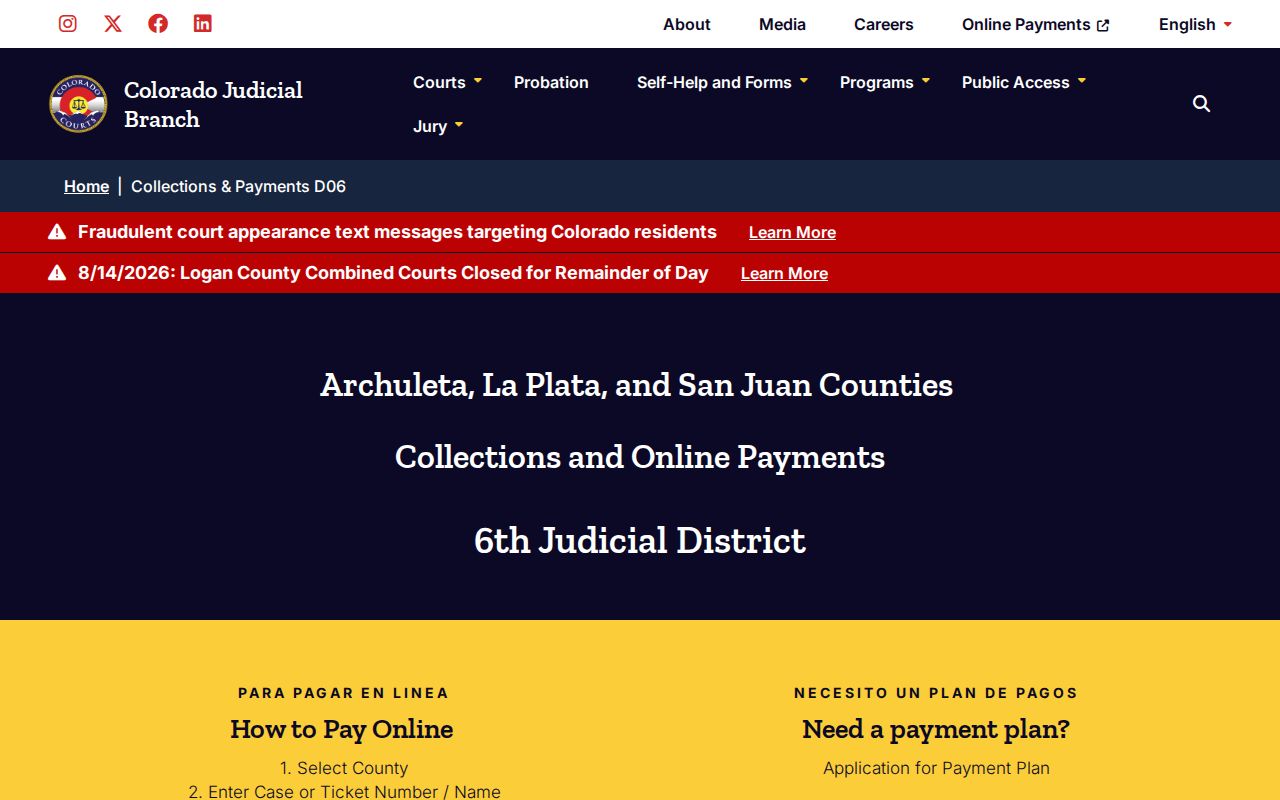
Payment details are only one late chapter of a criminal record. They cannot replace the hearing calendar, the ROA, or the sentence order when you need the full picture of a case.
Sealed Dockets and Public Access
Colorado promises reasonable public access, yet some criminal records stay out of remote view. A file can be protected, restricted, suppressed, sealed, or redacted under a statute, a rule, a directive, a local order, or a case-specific judicial order. Juvenile matters get their own layer of confidentiality. So an empty result in a docket search may reflect an access limit rather than a failed lookup.
Key rules:
Chief Justice Directive 05-01 governs access, exclusions, remote access, and correction of Colorado court records.
Colorado Rule of Criminal Procedure 55.1 requires findings before access to a filed criminal court record is restricted.
Colorado Title 19 supplies confidentiality rules for juvenile records.
If access is limited, call the clerk with the case number and explain your role. Ask what identification, motion, order, or redacted version the court needs. A court ROA is not the same product. It differs from a Colorado Bureau of Investigation criminal-history report. For a state case lookup by name or number, use the La Plata County case lookup.
La Plata Criminal Docket Context
The Sixth Judicial District spans La Plata, Archuleta, and San Juan counties. Its January 2025 overview counted 2,236 District Court filings and 2,234 terminations in fiscal 2024. It also counted 5,262 County Court filings and 5,126 terminations. Those figures cover all three counties. They are not La Plata County criminal counts. They also say nothing about the pace or outcome of any single case.
The volume still tells you something useful. It shows why County Court's misdemeanor and traffic calendar takes up so much of the local docket load. Filter by court type and case class instead of browsing every result. That habit cuts false matches. It also keeps a CR felony event apart from an M misdemeanor or a T traffic setting.