
Searching La Plata County Civil Dockets
For a hearing date, go first to the Colorado Judicial Branch Docket Search. Pick La Plata County. Set a date range, and add at least one more filter. A full case number narrows things best. A name works too. Spelling, the date window, and the court level all shape the results. Remember that each hit is a scheduled event, not the full La Plata County civil Register of Action.
Work the official channels in order. The calendar is free. A Judicial Branch-linked commercial vendor can sell real-time ROA index data, while the Record/Document Request Form reaches the clerk for the ROA or a named filing. Calling, emailing, or visiting the Combined Courts clerk also works. Older files may need off-site retrieval. A verbatim hearing transcript comes from the court reporter. It does not come from the clerk's ordinary document queue.
- Identify District Court or County Court from the claim and case class.
- Search La Plata County with the latest likely hearing window and a case, party, attorney, or division filter.
- Open the matching calendar card and note the case number, courtroom, hearing type, and appearance field.
- Request the ROA to trace filings, orders, resets, and judgment activity.
- Ask the clerk for each exact pleading or authenticated copy needed.
La Plata County Civil Docket Court Line
One courthouse houses both state trial levels. But a civil docket belongs to a court, not a building. The Sixth Judicial District Court takes general civil matters with no monetary ceiling. It also handles domestic relations and probate. La Plata County Court is different. It hears civil claims through $25,000, plus small claims, eviction and forcible-entry matters, protection orders, foreign judgments, name changes, and replevin. Replevin simply means a claim to get personal property back.
| Court | La Plata County civil docket work | Useful clue |
|---|---|---|
| Sixth Judicial District Court | General civil, domestic relations, probate, and other broad-jurisdiction matters | C, CV, DR, PR, or related class |
| La Plata County Court | Claims through $25,000, small claims, and other limited civil matters | C, S, or related county class |
| Municipal court | No ordinary civil claims | Local ordinance cases belong to a different record system |
This line heads off a common mistake. A small claim stays in La Plata County Court. Colorado has no local justice-of-the-peace docket to search. No civil claim moves to the Durango, Bayfield, or Ignacio municipal court. The Combined Courts clerk at 1060 East Second Avenue, Suite 106 in Durango keeps both state levels. Call 970-247-2304 to confirm the right file.
Inside a La Plata County Civil Docket
Think of the civil ROA as a dated index of activity. Begin with the court, division, filing date, caption, status, and party roles. From there, track the complaint or petition. Then follow service, the answer or response, motions, notices, minute orders, and hearing settings. Later entries may show dismissal. An order for judgment, judgment, a transcript of judgment, satisfaction, or appeal can appear too. The free calendar only shows the setting layer. It cannot prove a motion was granted or that the dispute ended.
| Case number | Four-digit year, civil class, and sequence, such as 2026CV123. |
|---|---|
| Court and division | The District or County Court assignment and the division handling the matter. |
| Caption and parties | The case title plus plaintiff, petitioner, defendant, or respondent roles. |
| Filed events | Complaint, service, response, motion, notice, minute order, and other indexed activity. |
| Settings | Date, time, duration, hearing type, place, appearance type, and courtroom when public. |
| Outcome fields | Dismissal, judgment, satisfaction, enforcement, or appeal entries when recorded. |
The Judicial Branch's Colorado Courts E-Filing overview names the state filing platform. Even so, online index access never turns the free calendar into a document viewer, and the overview spells out that filing layer for what it is.
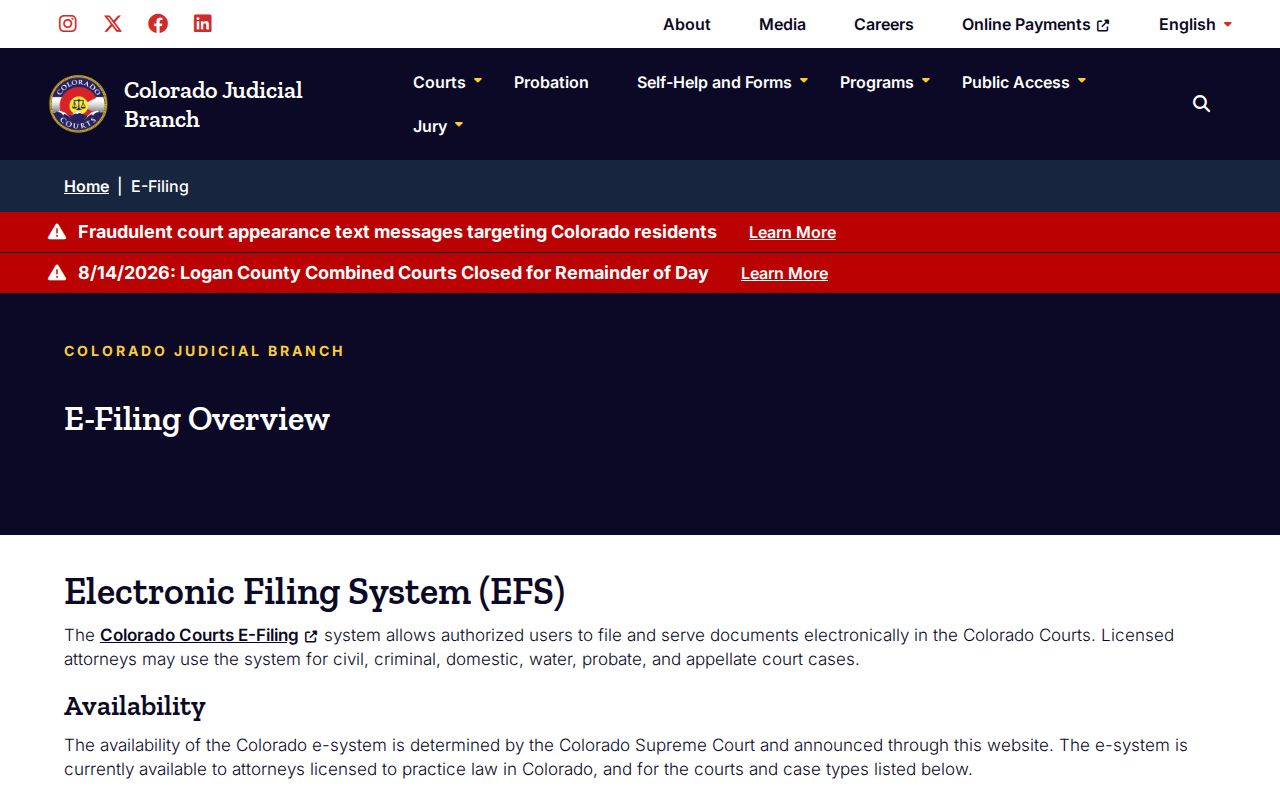
The separation matters. An entry naming an order is not a copy of that order, and a calendar card is not the complete civil case history.
La Plata County Civil Docket CCE
Colorado Courts E-Filing, or CCE, is the filing and authorized case-access layer. Attorneys use it across civil, domestic, probate, criminal, and appellate cases. A self-represented person gets a narrower route. That person must register and opt in. The eligible case must be their own, mainly a domestic-relations or eviction matter. Court review of an opt-in can take up to two business days.
Under the current model, search costs nothing. Case-history access runs $15 for 14 days. That price applies when the user has not filed in the case. Document viewing is free once access exists. None of this opens every civil file to the public. The system grew over time. Statewide civil e-filing started in June 2013, and self-represented domestic-relations access arrived in 2019. The Judicial Branch posts the non-attorney e-filing and opt-in rules on its official service page.
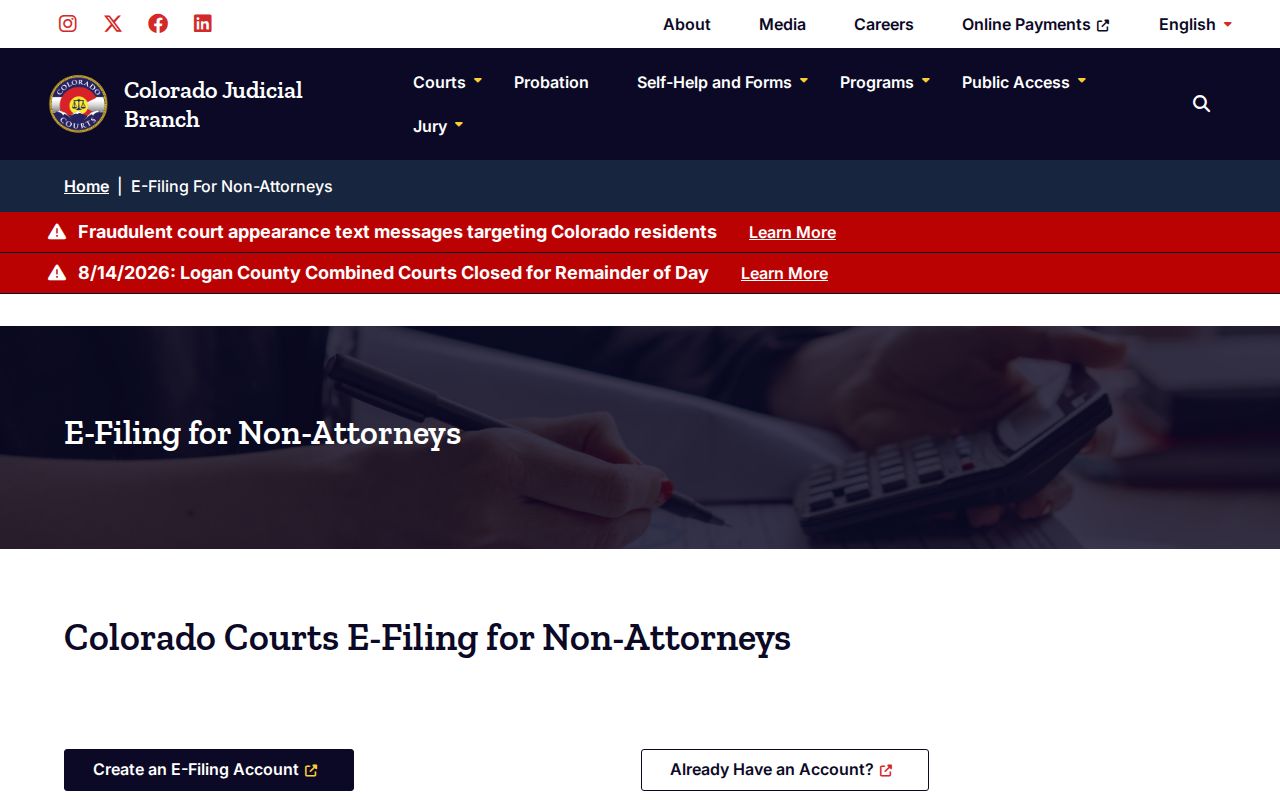
That page serves a party seeking access to an eligible case of their own. Everyone else should use the public calendar. Or use the ROA channel or clerk request that fits the item wanted.
Civil Case Types on the Docket
La Plata County civil dockets sort proceedings by case class. C and CV mark civil matters. DR points to domestic relations. S flags small claims, and R appears among the state portal's selectable classes. Probate material runs through District Court, since no separate elected probate court exists here. A class narrows a search. But the caption and ROA still define the dispute.
- C or CV
- Civil classes used for claims and related proceedings at the proper state trial level.
- DR
- Domestic-relations matters, with access limits for some family documents.
- S
- Small claims in La Plata County Court, capped at $7,500 under the cited statewide guidance.
- R
- A selectable state case class that should be read with the court and caption rather than guessed from the letter alone.
County Court filing tiers help explain the classification too. State guidance sets different filing and response charges for claims below $1,000, from $1,000 through $14,999.99, and from $15,000 through $25,000. Those are filing costs only. They are not the fee for an ROA, a document copy, or certification. The current form and the clerk's assessment control any amount due.
La Plata County Civil Docket Request Fields
The statewide request form is built to help the clerk pull the right item. So fill it in with care. Give the case number if you have it, plus the case type and filing year. Pick La Plata County as the location. Party names and any other identifying detail you can add will keep the clerk from hunting through the civil docket by hand. That saves research time and copying fees.
| Request choice | What it identifies | When it helps |
|---|---|---|
| Register of Action / ROA | The chronological case summary | Tracing the full sequence before choosing documents |
| Order for Judgment | The court’s judgment order | Reading the actual ruling rather than an index label |
| Transcript of Judgment | A clerk-issued judgment record | When that distinct product is required |
| Satisfaction of Judgment | The record that an obligation has been satisfied | Confirming post-judgment status |
| Protection Order | A named order, subject to access controls | Requesting the order itself |
| Certification or exemplification | Clerk authentication added to a copy | Only when an official process calls for it |
Checkboxes for domestic and probate matters sit apart on the form. So tick the one that matches your civil case. Some protected court records require government-issued photo ID before the clerk will release them. Online responses usually start within three business days when nothing unusual slows things down. Off-site material from older files can stretch the wait. Retrieval may add an actual cost.
Civil Docket Settings and Hearings
A La Plata County calendar card might list several kinds of settings. Examples include a status conference, a motion hearing, a pretrial conference, a pretrial readiness conference, or a final hearing. Read those words as settings, never as outcomes. Duration is only the time the court set aside. It is not proof of how long anything lasted. Appearance type and courtroom count too. When the appearance field sits blank, La Plata County wants parties in person unless phone or Webex attendance was approved ahead of time. Resets and continuances live in the ROA. An older setting can linger on the civil docket even after the court moves the date. Scan later entries for a new notice, a minute order, a reset, or a continuance. Then confirm whichever date is most recent. The current order and the court's own notice always control. The La Plata County Court Dates resource walks through the calendar in more depth.
If a setting changed: compare the newest ROA entry with the latest court notice, then call the Combined Courts clerk at 970-247-2304 before the hearing.
La Plata County Civil Docket Judgment Path
A La Plata County civil docket can continue after the judge rules. The event line often reads in stages: complaint or petition → service → response → motions → settings → order or judgment → transcript or satisfaction → appeal. A judgment entry records a court determination. A transcript of judgment is a separate clerk-issued product used to evidence that judgment. A satisfaction records that the obligation has been met.
Each product on the judgment path carries its own charge in the current schedule. A transcript of judgment runs $25, and a certificate of satisfaction costs $20. Certification or exemplification adds $20 per document on top of copying. Electronic copies are listed at $0.25 per page. A clerk-produced paper copy may run $0.75 per page. Under CJD 06-01 and C.R.S. §13-32-104, the clerk supplies the final estimate. Ask by name. "The judgment" might mean an ROA event, the signed order, or the clerk's transcript. Each is a different purchase. Precise wording keeps you from paying for the wrong item.
Civil Docket Access Rules
Chief Justice Directive 05-01 governs access to Colorado court-case records. It stands apart from the Colorado Open Records Act process that covers many agency files. Route a request for a La Plata County civil ROA, pleading, or order through the court-record channel. Judicial administrative records follow a separate Chapter 38 rule. That rule borrows from CORA but does not control trial-case access. Public access has limits. Family, juvenile, probate, sealed, suppressed, confidential, or protected material may be limited remotely. It may also be withheld without proof of authority. Redaction hides protected details; sealing limits a document; suppression can reach the whole case. A blank search result proves nothing about whether a civil matter exists.
Key rules: CJD 05-01 governs access, exclusions, vendor access, and correction for Colorado court records. CJD 06-01 governs retrieval, research, redaction, copying, and scanning charges. C.R.S. §13-32-104 supplies court-copy and certification fee authority.
When access runs into a wall, call the clerk with the case number in hand. Explain your role in the case and ask what ID, motion, order, or redacted form the court needs. Repeated name searches are not a way around a restriction.
La Plata County Civil Docket Documents
The free calendar, the ROA, and the case file each answer a different question. Each one concerns a civil matter in La Plata County. The calendar tells you when and where a hearing is set. The ROA lists what happened, in date order. The filed document holds the actual argument, evidence, order, or judgment. A certified copy adds clerk authentication on top of all that. Mix these products up and your civil search comes home incomplete. That happens more often than anything else. The official Colorado fee-waiver page covers a separate civil filing service with its own rules. That service is distinct from public docket access.
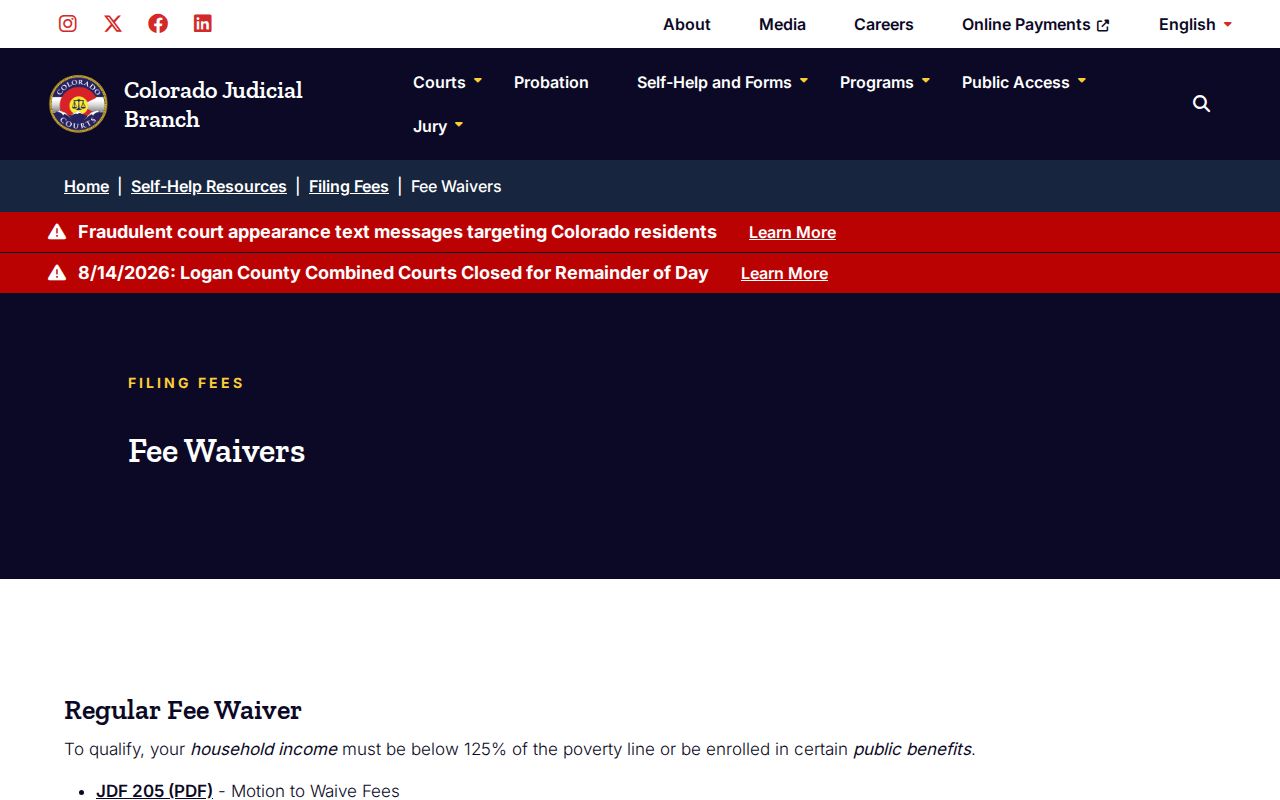
A waiver can cover an eligible person's court fees. But it will not turn the hearing calendar into a document viewer. Use the clerk's form for the ROA or a named filing. Ask only for what the civil docket shows is needed. A calendar entry naming a motion or judgment proves the event was indexed. It says nothing about what the filed paper actually says.